Showing posts with label natural daylight. Show all posts

22 January 2009

Focussing on people: working

Health and comfort are the most important prerequisites to our motivation, our productivity and to rich emotional experiences. Whether in the working world, in healthcare services, in hotels and restaurants or in boutiques, lighting has to be interpreted in a way that supports and promotes well-being and health.

Light has a great effect on our physical and mental state. In our quest to balance between movement and rest, between tension and relaxation, we need light that is modeled on the natural rhythm of daylight. We need to light with expectations.

The demands we make on our surroundings are continually increasing. This is particularly true of the quality of light, and of the design and aesthetics of the lighting fixture. Beyond the individual factors, it is important to consider the complete context: the characteristics of the rooms, workplaces and equipment, as well as the type of activities and the type of organization, so that the lighting design is tailor-made to suit the user and the specific environment.

Nowadays, an appropriate light management system has become indispensable and plays a particularly important role. The lighting control must be simple to operate, so that every user can regulate the light to suit the activity of the moment and in accordance with its own preferences. Pre programmed light scenarios and automatic daylight dependant illumination management also become standard in up-to-date illumination control.

In a working environment, an employer will express consideration for its employees and clients by providing high quality lighting solutions. Individual lighting control favors the appropriation by the employees and reinforces the feeling of belonging to an identity, and provides a positive corporate image for the outside. This in turn creates a positive impact on motivation.

14 December 2008

Blue light, yellow light

The quality and quantity of light influence the way we experience color: objects’ surfaces reflect only colors whose spectrum wavelengths are present in the illuminating light source.

The blue color is at its most beautiful in natural light because the incandescent lamp's yellowish light does not reproduce blue wavelengths. As today most indoor artificial light sources are still incandescent lamps, most indoor lighting is extremely yellowish. Consequently indoor blue colors under artificial light appear stuffy, even dirty and dull. They may even look greenish. On the other hand, yellows, oranges and reddish colors usually look good in the light given off by incandescent lamps.

In recent years, compact fluorescent lamps have proliferated as a result of their low energy consumption. Low energy consumption is an obvious economic advantage, but from the standpoint of color rendition compact fluorescent lamps are extremely problematic. They have an uneven spectral distribution, leading to situations where a colored surface may appear of a tint that has not been observed in normal daylight.

Because of the different kinds of spectral distributions in artificial light sources it is extremely important to check the colors in question under the lighting conditions where they will be actually used. Owing to its slightly bluish tint, natural light entering a space could significantly alter its color situation, unless the space has been designed with light source that imitate daylight.

25 February 2008

Out in the midday sunshine

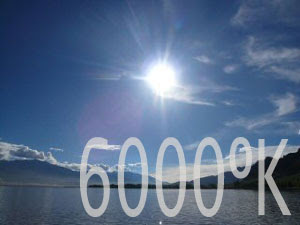
With a color temperature of 6000 ºKelvin, noon sunlight renders neutral colors. It has a color temperature similar to that of flash systems.

It is light that enhance or blur a detail. It is light that creates the illusion of depth, underline the textures and establish the ambiance.

When the sun is at its highest point in the sky the light is at its whitest and strongest. Contrast is very high. Shadows are very dark, so dark in fact that they generally appear black, although it is still possible to see some detail in the shadows.

To complicate matters, atmospheric haze and reflections become much more visible. Haze and reflections cause bright colors to lose saturation and wash out. They appear to be less saturated than at other times of the day. The strong contrast makes it difficult to appreciate objects, and above all "white" skin, in this sort of light. Shadows will "block up", highlights will blow out, or both. However in situations where contrast is naturally lower it can produce very appealing scenes. Water for example can really benefit from this strong light.

At noon, the small shadows and strong light are not very good at revealing or enhancing forms and details, and the low color saturation adds further flattening to a scene.

24 February 2008

In the gloaming

In the gloaming, the air stills, birds sound their final calls of the day, and the light often turns golden; we find ourselves introspective as our visual perceptions, attitudes and pace of life shifts. The gloaming symbolizes intertwining of the dark and light.

"Gloaming" is the Scottish word for twilight, that transition time between the day and the night. It is recognized by the presence of weak sunlight, while the sun itself is below the horizon.

On clear days, there is always a yellow, orange or sometimes pink glow to the west where the sun is illuminating the sky from below the horizon. Whereas the glow from the sun can last for over an hour after sunset, the color in the eastern sky is much shorter lived, and changes very fast. In overcast conditions the skylight is always blue and generally much darker, with night falling more quickly.

On clear days, there is often a pink area in the eastern sky at dusk. This phenomenon is called alpenglow. Alpenglow cast a noticeable pink light onto reflective surfaces, such as white walls or water, but is too faint to affect darker surfaces such as foliage. As a result the landscape can look very dark at this time. When the weather is overcast, the eastern sky is just blue.

Twilight is a very special time of day with unpredictable but often very beautiful lighting. Since the sun is not above the horizon, the sky itself is the only source of natural daylight. As a result the light is very soft, with little shadow and contrast and the colors can be very delicate but vividly saturated.

23 February 2008

The ultimate sidelight

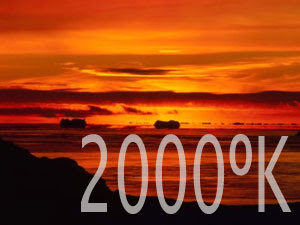
The light changes rapidly at sunrise and sunset. With the sun low on the horizon, the color temperature of the light could get as low as 2000 ºKelvin, giving these moments their characteristic yellow, orange, pink and red tones

As I mentioned earlier, the largest changes of natural daylight are at sunrise and sunset. Furthermore, if one observes several sunsets and sunrises in succession, it becomes obvious that they are very varied in terms of color and atmosphere: in fact no two one will be the same.

Sunset and sunrise light is the best sidelight, because at those times the light is horizontal. As its name implies, horizontal light is parallel to the horizon, and when grazing an object will give it a strong three dimensional quality. We perceive this sidelight as aesthetically pleasing because it enhance our three dimensional perception.

At sunrise and sunset, the sun is just above the horizon, and sunlight has to go through many layers of dust, haze and pollution before it reaches the earth surface. During this travel, as dust and haze scatter the sunlight, its intensity is greatly diminished and softened. The scattering also removes the green and blue radiations, leaving mostly the red part of the visible spectrum. As a result, sunrise and sunset light is warm, and depending on the particular day, tinted of pink, red or orange.

Sunrise and sunset light is also rather weak, which in turns means that contrast is very low. This weak sunlight also means that skylight takes on a greater importance and shadow areas become a deeper and richer shade of blue. Shadows at sunrise and sunset are very long, and any texture is very apparent.

The combination of diffused light and of the warm glow of sunrise and sunset creates a light which is extremely pleasing to the eye. If there are any clouds, the sky during these moments can be incredibly colorful. Unlike during the rest of the day, clouds are lit from below, and usually take on dramatic red or orange hues. The reflection of these colors adds complexity to the color of the skylight, and shadow areas sometimes turns purple or pink.

22 February 2008

The effervescence of natural daylight

Artificial lighting of the future will give off natural daylight.

And to that extent will probably remain an illusion, as natural daylight can only ever be grossly imitated.

Natural daylight comes in a wide variety of forms, and the difference between each of them can be enormous. The source of all our natural light is the sun; however it presents very different characteristics at different times of day and in different weather conditions. Instead of a single source of light we end up with many different ones ranging from hard to soft and warm to cool. Without preaching the obvious, two very common observations are enough to be convinced of the extraordinary dynamics of natural daylight.

Sunlight has a different character at different times of day. Our atmosphere scatters the shorter wavelengths of light with the effects of creating the blue of the sky and reddening the light from the sun itself. The thicker the layer of atmosphere that sunlight has to travel through, the more scattering occurs. This is exactly what happens as the sun gets low on the horizon, thus causing more scattering at the beginning and the end of the day.

Clouds also have a major influence on both the color and the character of sunlight. Clouds are translucent. They let light pass through in a diffuse manner, deflected by the water mist they contain. Rays of light are bouncing around to emerge from several directions. This phenomenon is similar to the scattering of blue light by the atmosphere, except that in clouds the scattering occurs across all wavelengths, not just the shorter ones. Clouds also affect colors, since they usually hide the blue sky and the light emanating from it.

About This Blog

Form is the visual shape of mass and volume. Light makes form legible. There is no form without light.

Comments

This blog does not provide a comment feature, because it only expresses my opinion.
If you want to comment, write about it at your own blog and link back to this blog. If you want to comment in private,
.
Alternatively you can make suggestions on the content.

hCard

Template Design | Elque 2007